

About UsPricingReviewsContact UsClient Portal loginBook a Free 30-Min Call
TL;DR:
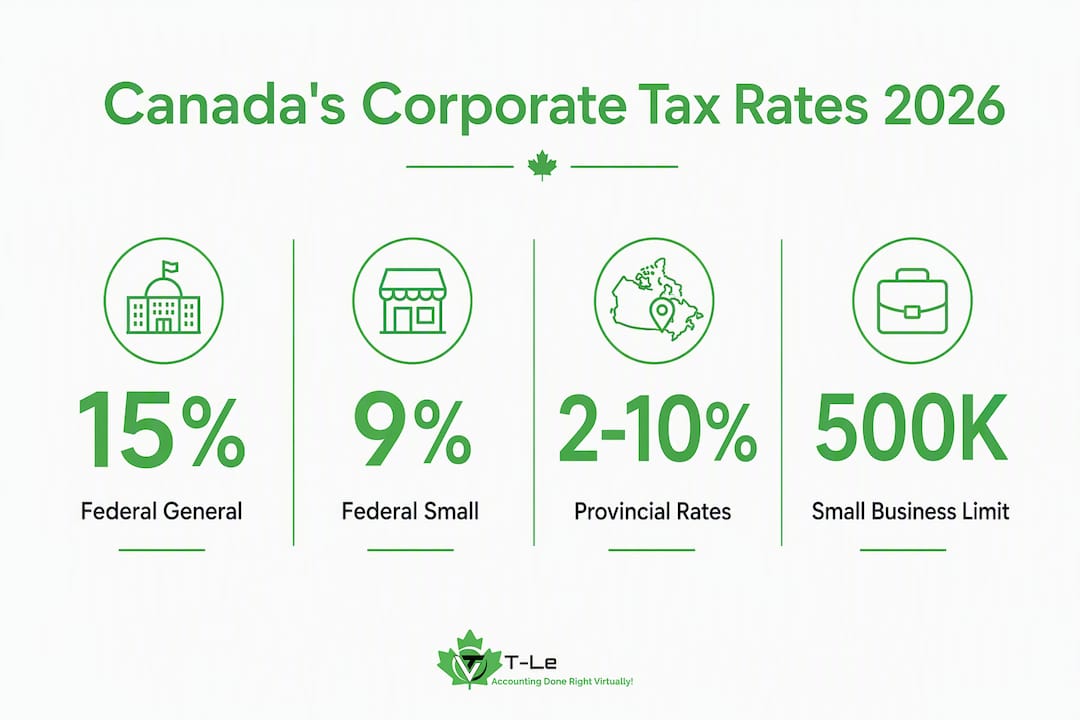
- In 2026, Canada’s federal corporate tax rates include a 15% general rate and a 9% small-business rate for eligible CCPCs.
- Add your province’s rate on top: combined small-business rates run from about 9% to 12%, and combined general rates from 23% to 30%. In Ontario, the combined small-business rate drops to 11.2% from July 1, 2026 (9% federal + 2.2% Ontario).
For 2026, the federal net general corporate tax rate is 15% and the federal small-business rate is 9% for eligible Canadian-controlled private corporations (CCPCs). You add your province’s rate on top to get your combined liability. Combined rates vary by province and territory. For example, Ontario’s combined small-business rate is 11.2% from July 1, 2026 (9% federal + 2.2% Ontario), and its combined general rate is 26.5%.
Quick summary:
Jump to the provincial comparison table below to find your jurisdiction’s combined rate.
The federal Part I tax starts at a basic rate of 38% of taxable income. After the federal abatement, that rate reduces, followed by a general rate reduction that brings the net rate down to a lower percentage for most corporations. CCPCs with small-business deduction eligibility pay a reduced net federal rate on active business income up to the business limit, which differs from the general rate due to the SBD replacing the general reduction for that portion of income.

ZETM temporary rates: Corporations earning income from qualifying zero-emission technology manufacturing pay temporarily reduced federal rates on that income. These reduced rates are scheduled for phase out; confirm current timelines with the CRA corporation tax rates page before filing.
Banks and life insurers surcharge: An additional tax applies to banks and life insurance companies on taxable income above an exemption threshold, remaining in effect currently.
CRA is the authoritative source for all federal rates. The Canada Revenue Agency publishes its official corporation tax rates table at Canada.ca and updates it when federal budgets or legislation change rates. Always confirm the rate in effect for your specific taxation year before filing your T2.
Every province and territory sets its own corporate tax rates, applied on top of the federal component. The table below shows the lower (small-business) and general rates for each jurisdiction, along with the provincial business limit and combined federal + provincial examples where applicable.

2026 combined federal + provincial/territorial corporate income tax rates
Swipe to see all columns →
| Province / Territory | Combined small-business rate | Combined general rate | Business limit |
|---|---|---|---|
| British Columbia | 11% | 27% | $500,000 |
| Alberta | 11% | 23% | $500,000 |
| Saskatchewan | 10% | 27% | $600,000 |
| Manitoba | 9% | 27% | $500,000 |
| Ontario | 11.2% (from Jul 1, 2026; 12.2% before) | 26.5% | $500,000 |
| Quebec* | 11.2% for tax years starting after April 29, 2026 (12.2% before; 5,500-hour test applies) | 26.5% | $500,000 |
| New Brunswick | 11.5% | 29% | $500,000 |
| Nova Scotia | 10.5% | 29% | $700,000 |
| Prince Edward Island | 10% | 30% | $600,000 |
| Newfoundland & Labrador | 11% (from Jan 1, 2026; 11.5% before) | 30% | $500,000 |
| Northwest Territories | 11% | 26.5% | $500,000 |
| Nunavut | 12% | 27% | $500,000 |
| Yukon | 9% | 27% | $500,000 |
Rates as of October 12, 2026. Combined = federal net rate (9% small-business, 15% general) + provincial/territorial rate. Sources: CRA corporation tax rates (canada.ca); Ontario Ministry of Finance; Alberta corporate income tax; Revenu Québec; BC provincial rates; SNL 2026 c.14, s.4; NL Budget 2026 highlights; EY corporate tax rates 2026 (Jan 2026 snapshot; some provinces changed since). Newfoundland & Labrador’s provincial small-business rate is 2% from Jan 1, 2026, dropping to 1.5% on Jan 1, 2027 and 1% on Jan 1, 2028. Alberta and Quebec administer their own corporate income tax. *Quebec: combined small-business rate is 11.2% for tax years starting after April 29, 2026 (12.2% before), per Finances Québec Information Bulletin 2026-3. The full small-business rate requires at least 5,500 paid hours (employee-hours test) in the year. If a rate changes mid-year, it is prorated by days.
Notable exceptions to the standard $500,000 limit:
Alberta stands out for a comparatively low general provincial rate, producing one of the lowest combined general rates in the country. For BC-based businesses, the most recent budget confirmed no rate changes, maintaining prior combined small-business and general rate levels.
A corporation qualifies for the small-business deduction if it was a Canadian-controlled private corporation (CCPC) throughout the entire taxation year and earned active business income within its available business limit. That is the short answer. The details, however, trip up many business owners.
The $500,000 business limit is not per corporation. It is a shared pool across all associated corporations. If you own two CCPCs that are associated, they must allocate the limit between them using Schedule 23. Fail to file Schedule 23 and the Income Tax Act sets each corporation’s business limit to nil. That is a costly default that catches many multi-corporation owners off guard.
Two separate mechanisms can shrink your available limit:
Corporations with short taxation years (fewer than 51 weeks) must prorate the business limit based on the number of days in the year. New incorporations frequently miss this, resulting in an overstated SBD claim.
Common pitfalls to watch for:
Pro Tip: If your corporation holds significant investments or you own multiple related companies, a review with a virtual CFO before year-end can identify limit-reduction risks before they become a tax bill surprise.
The formula is straightforward:
Combined tax = (Federal rate + Provincial rate) × Taxable income in that category
For a CCPC claiming the SBD in BC on active business income within the $500,000 limit, that is: (9% + 2%) × income = 11% combined rate.
| Component | Calculation | Amount |
|---|---|---|
| Taxable active business income | — | $100,000 |
| Federal SBD rate | 9% × $100,000 | $9,000 |
| BC small-business rate | 2% × $100,000 | $2,000 |
| Total combined tax | $11,000 |
That leaves $89,000 after tax on $100,000 of qualifying active income. If the same income were taxed at the general combined rate of 27% (federal 15% + BC 12%), the bill would be $27,000 instead.
A note on non-eligible income: Investment income earned inside a CCPC does not qualify for the SBD and is subject to a higher refundable corporate tax regime. Combined effective rates on passive investment income can exceed 50% in some provinces, which is why distributing or structuring investment income carefully matters. Personal services business income is also excluded from the SBD and taxed at the general rate plus an additional 5% federal surtax.
Your actual tax entries flow through Schedule 1 (net income for tax purposes) and Schedule 5 (tax calculation) of the T2 return. Always verify the rates in effect for your specific taxation year on the CRA and provincial pages before filing. You can also use a net proceeds calculator as a quick sanity check on after-tax amounts.
Rates can change with federal and provincial budgets, sometimes mid-year. Here is a practical checklist to keep your calculations current:
For cross-provincial comparisons, the EY 2026 corporate tax rates summary (updated to January 15, 2026) is a reliable professional reference. Bookmark the CRA page as your primary source and check it after each federal budget.
This article provides general information about Canadian corporate tax rates and is not a substitute for professional tax advice. Confirm current rates and eligibility rules with the CRA, your provincial tax authority, or a qualified tax professional for your specific situation.
Canada’s combined corporate tax rate for a BC CCPC earning active business income within the $500,000 limit is 11%, rising to 27% at the general rate — and passive income can push effective rates significantly higher.
| Point | Details |
|---|---|
| Federal net rates | General rate is 15%; small-business rate is 9% for eligible CCPCs on active income. |
| BC combined rates | Small-business combined rate is 11% (federal 9% + BC 2%); general combined rate is 27% (federal 15% + BC 12%) for 2026. |
| SBD eligibility | Only CCPCs with active business income qualify; passive income is excluded and taxed at higher rates. |
| Business limit is shared | Associated corporations must allocate the $500,000 limit via Schedule 23 or each corporation’s limit defaults to nil. |
| T-Ledgers can help | T-Ledgers offers corporate tax filing and virtual CFO services to manage SBD eligibility, limit allocation, and T2 preparation. |
Most conversations about Canadian corporate tax focus on the headline rates. That is understandable, but in practice the rate is rarely where businesses lose money. The real cost comes from mismanaging the small-business deduction.
The gap between 11% and 27% on $500,000 of income is $80,000. That is the annual cost of losing the SBD entirely. Yet many business owners with multiple corporations assume each entity gets its own full limit. They do not file Schedule 23. They do not track passive income against the $50,000 threshold. They incorporate mid-year and forget to prorate. By the time the error surfaces, it is often in a CRA reassessment rather than a planning conversation.
The passive income trap is particularly underappreciated. A CCPC that accumulates investment income inside the corporation can inadvertently reduce its own SBD eligibility for the following year. The reduction begins at $50,000 of adjusted aggregate investment income and eliminates the limit entirely at $150,000. That is a narrow band, and it catches profitable small businesses that reinvest earnings rather than distribute them.
The rate table is a starting point. The planning work happens in the details.
Knowing the rates is one thing. Applying them correctly to your T2, managing your small-business limit across associated corporations, and tracking passive income thresholds is where most business owners need support.

T-Ledgers is a fully remote Canadian accounting firm that handles corporate tax filing and virtual CFO services for small businesses and growing companies across British Columbia. The flat-rate pricing model means you know the cost upfront, with no hourly billing surprises. Whether you need a T2 prepared accurately, your SBD eligibility reviewed, or an ongoing adviser to flag passive income risks before year-end, T-Ledgers has CPAs ready to help. Book a consultation today to confirm your combined rate and make sure your corporation is claiming every deduction it is entitled to.
| Source | What it covers | Last checked |
|---|---|---|
| CRA corporation tax rates | Federal Part I rates, abatement, SBD, ZETM rates | January 2026 |
| BC provincial corporate tax rates | BC small-business (2%) and general rates, Schedule 23 notes | January 2026 |
| EY 2026 corporate tax rates summary | Combined federal + provincial rates for all provinces; business limit exceptions | January 15, 2026 |
| CRA T4012 T2 guide | Prorating rules, short taxation years, SBD calculation mechanics | 2025 edition |
| CRA small-business deduction rules | Passive income business limit reduction, taxable capital reduction formulas | Current |
Alberta offers one of the lowest combined general corporate rates, reflecting its comparatively low provincial general rate added to the 15% federal net rate. At the small-business level, Manitoba’s provincial rate combined with the federal small-business rate produces a combined rate consistent with federal and provincial rates for eligible CCPCs.
A combined rate between the general and small-business combined rates is typical for many provinces. In British Columbia, the combined general rate is 27% (federal 15% + BC 12%), and the combined small-business rate is 11% (federal 9% + BC 2%) for qualifying CCPCs.
The business limit is the maximum amount of active business income on which a CCPC can claim the small-business deduction in a taxation year. It is shared across associated corporations and must be allocated using Schedule 23; it is also prorated for short taxation years.
A BC CCPC qualifying for the small-business deduction pays combined federal and provincial tax reflecting the sum of applicable rates on active business income. The general combined rate results in a higher tax amount on the same income.
When a CCPC’s adjusted aggregate investment income exceeds a threshold in the prior year, the business limit begins to phase out, potentially eliminating SBD eligibility entirely for that taxation year.
Last updated: October 18, 2026