



About UsPricingReviewsContact UsClient Portal loginBook a Free 30-Min Call
Last updated: October 16, 2026
A virtual CFO is the fastest, most cost-effective way to get CFO-level leadership without hiring full-time, and the smartest first move is prioritizing a Canadian provider who quotes fees in CAD. This avoids the currency exposure that quietly inflates budgets for businesses working with USD-quoted firms. Before you sign anything, ask for a 30/60/90-day onboarding plan and confirm the currency of every number on the proposal.
TL;DR:
- Choosing a virtual CFO quoting in CAD minimizes currency risk, as USD-based quotes can increase costs by 8 to 10 percent due to exchange rate fluctuations.
- Virtual CFO services range from CA$3,000 to over CA$14,000 per month, with flat-rate CAD pricing offering greater cost stability and transparency.
- Proven providers should offer clear scope, measurable deliverables, and a detailed onboarding plan within the first 30 to 90 days to ensure quick value realization.
- Sector-specific experience and technology fluency are crucial, as the best CFOs understand industry nuances and integrate seamlessly with existing cloud-based systems.
- Full-time CFOs typically become necessary for businesses exceeding CA$20 to 30 million in revenue or requiring constant in-person decision-making.
Most business owners don’t wake up one morning deciding they need a CFO. Something forces the decision. Revenue climbs past what your bookkeeper’s monthly report can explain. A lender or investor asks for financial models you don’t have. Or you’re personally still doing cash-flow projections in a spreadsheet at 11 p.m. because nobody else in the business can.
A virtual CFO addresses these pressure points directly, supplying CFO-level expertise on a part-time or remote basis rather than requiring a six-figure full-time salary and benefits package. That distinction matters more in 2026 than it did five years ago, because more Canadian SMEs are actively comparing fractional and virtual options against traditional hires, driven partly by tighter lending standards and partly by founders who’ve realized they can get senior financial judgment without the overhead.
The triggers that typically push a business toward this decision include:
The return on hiring shows up fastest in three areas: forecasting accuracy, disciplined cash management, and investor-ready materials. An owner who previously guessed at runway can suddenly see it modelled twelve months out. A business that used to discover a cash crunch the week it happened starts spotting it two months in advance. None of this requires a full finance department. It requires one experienced person looking at the right numbers on a set schedule, which is precisely what virtual CFO services for startups are built to deliver without the commitment of a permanent executive hire.
Job titles in this space get used loosely, and that looseness costs buyers money. Before comparing prices, compare scope. Two firms quoting similar retainers can deliver wildly different work if one is doing strategic modelling and the other is essentially glorified bookkeeping oversight with a CFO label attached.
A properly scoped engagement typically breaks into three tiers of work:
A virtual CFO covers cash-flow forecasting, financial modelling, budgeting, and fundraising support as core functions, not add-ons billed separately. If a proposal treats forecasting as an “upgrade” rather than a baseline deliverable, that’s worth questioning.
Pro Tip: Ask any prospective provider to show you a sample KPI dashboard and a sample 13-week cash-flow forecast before you sign. If they can’t produce one, they likely haven’t built the reporting infrastructure to support your business yet.
The systems layer deserves more attention than most buyers give it. A virtual CFO who can’t move fluidly between cloud accounting platforms, or who insists you switch your entire tech stack to match their preferred tools, is going to slow you down rather than speed you up. Technology fluency isn’t a nice-to-have credential here. It’s the difference between a CFO who plugs into your existing operations within weeks and one who spends the first quarter forcing your business to adapt to their workflow instead of the other way around.
Canadian virtual CFO pricing in 2026 generally falls into three bands, and knowing which one applies to your business before you start requesting proposals will save you from comparing incompatible quotes.
Entry-level virtual CFO support for a smaller business, typically covering monthly reporting and light forecasting, runs from roughly CA$3,000 a month at the lower end, according to vendor pricing analysis from Eightx. A mid-tier retainer, adding deeper financial modelling, board-ready reporting, and more frequent strategic check-ins, sits meaningfully higher. Outsourced-firm solutions, where you’re getting a full bench of analysts and controllers behind a lead CFO, can run CA$14,000 a month or more depending on the complexity and revenue scale of your business.
Industry estimates put fractional and outsourced CFO services at 30 to 50 percent of the cost of a full-time CFO hire once you scale the comparison appropriately, factoring in salary, benefits, payroll taxes, and the recruiting cost of finding a qualified full-time executive.
Statistic Callout: Outsourced and fractional CFO engagements typically cost 30 to 50 percent of a full-time CFO’s total compensation, while delivering comparable strategic oversight for growing businesses.
The delivery model shapes the price as much as the scope does. A solo fractional practitioner trades bench depth for direct senior attention, meaning you’re getting the CFO’s own hours rather than a team of junior staff working under them. An outsourced firm trades some of that direct face-time for a wider bench, useful if you need heavy production work like detailed financial modelling done quickly. Neither model is objectively better. It depends on whether your business needs hands-on execution from a senior person or a small leadership overlay backed by deeper staffing.
Here’s where Canadian buyers get burned most often: currency. Some providers, particularly ones operating cross-border or headquartered outside Canada, quote fees in USD even when serving Canadian clients. That introduces foreign exchange risk and turns a fixed retainer into a moving target every time the Canadian dollar shifts against the US dollar. A CA$5,000 line item today could effectively cost you 8 to 10 percent more in six months purely on exchange rate movement, with zero change in the actual service delivered.
Before comparing any two proposals, run this checklist:
A provider quoting flat-rate CAD pricing from the outset removes this entire category of risk from the conversation.
Choosing a virtual CFO is less about finding the cheapest option and more about finding the provider whose scope, credentials, and communication style actually match how your business runs. The checklist below is what separates a rushed decision from a good one.
Start with these core evaluation criteria:
Pro Tip: Request references from businesses similar in size and revenue to yours, not just their biggest or most impressive client. A provider who’s great with a $10 million company might be a poor fit for a $500,000 startup, and vice versa.
During a discovery call or when reviewing a written proposal, ask these questions directly:
A clear 30/60/90-day plan at the proposal stage is one of the strongest signals of professionalism a virtual CFO can offer, and it tends to correlate directly with faster time-to-value once the engagement starts, according to procurement guidance from Capidel.
Watch for these red flags, because each one tends to predict a rocky engagement down the line:
None of these disqualify a provider outright on their own, but two or more together should give you pause before signing a retainer agreement.
The first 90 days determine whether a virtual CFO engagement becomes genuinely useful or stays a line item you’re quietly questioning by month four. A well-structured onboarding plan follows a predictable rhythm.
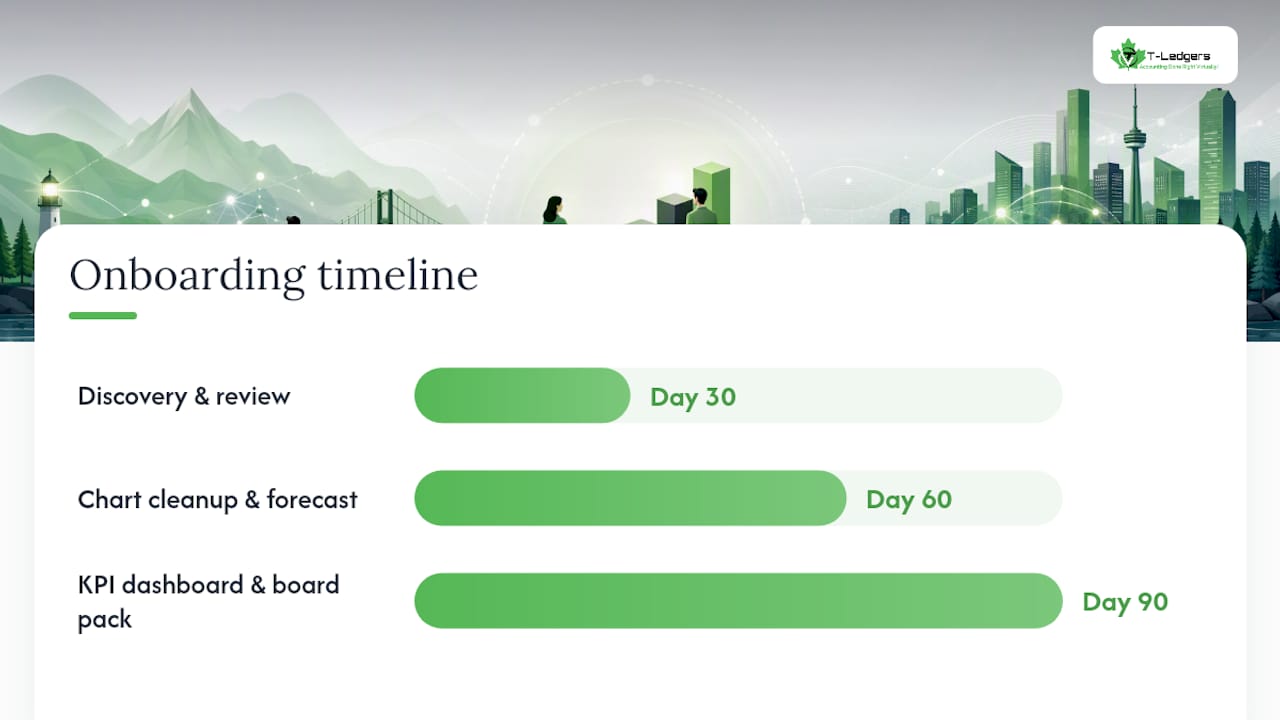
In the first 30 days, expect discovery work: a full review of your existing financial systems, chart of accounts, and historical data, along with introductions to key contacts on your team. This is also when any bookkeeping cleanup gets identified, because a CFO can’t build reliable forecasts on messy underlying records.
Days 31 to 60 typically bring the first real deliverables: a cleaned-up chart of accounts if one was needed, and a baseline cash-flow forecast built from your actual historical performance rather than generic assumptions. By day 90, you should have a functioning KPI dashboard and, if relevant to your situation, a board-ready reporting package suitable for investors or lenders.
A provider worth retaining should commit upfront to specific milestones, not vague assurances:
Your side of the bargain matters just as much. Onboarding speed depends heavily on how quickly you grant access to accounting systems and banking portals, introduce your CFO to relevant staff and vendors, and hand over historical financial records without delay. A business that drags its feet on system access in week one shouldn’t be surprised when the 90-day forecast slips into week 110.
A recommended option for virtual CFO services is a fully remote Canadian accounting firm with virtual CFO advisory led by professionals holding CPA designations. That credential isn’t a formality. It means the advisory guidance behind your forecasts and reporting is grounded in the same professional standards and accountability that govern audited financial statements, not informal consulting dressed up with a finance title.
What separates T-Ledgers Accounting from many providers in this space is the flat-rate pricing model. Instead of hourly billing that turns every phone call into a line item, clients pay a predetermined fee for the virtual CFO service package they select, quoted in CAD from the start. That removes the currency guesswork and the invoice surprises that erode trust in longer engagements.
Clients of some accounting firms have pointed to timely tax filings, clear communication, and deep industry knowledge as factors that made a significant difference in their financial confidence, according to client testimonials.
The remote delivery model also means you’re not restricted to CFOs within driving distance of your office. Some firms offer remote engagement through cloud-based collaboration and scheduled video check-ins, with consistent reporting cadence and access to CPA teams regardless of client location across Canada.
A first meeting with a virtual CFO provider typically starts with a discovery conversation covering current financial systems, pain points prompting the need for CFO services, and a walkthrough of the service packages offered, without pressure to commit on the first call. The goal is figuring out whether the scope matches your business before either side signs anything.
The Canadian market for virtual CFO services is genuinely competitive, and directories like Clutch list dozens of firms serving businesses across the country. What separates the strongest providers from the crowd isn’t marketing polish. It’s specificity.
The firms worth shortlisting tend to specialize rather than generalize. Some focus almost exclusively on early-stage tech companies preparing for a funding round, building financial models investors expect to see. Others concentrate on manufacturing or logistics businesses where inventory accounting and margin analysis by product line matter more than investor relations. A provider that tries to be equally good at every industry is often mediocre at most of them.
Pricing transparency is the second real differentiator. Flat-rate models eliminate the anxiety of an hourly clock running during every strategy call, while firms still billing by the hour create a quiet incentive misalignment: more of your problems, more billable time for them.
The third differentiator is reporting cadence and depth. Some providers deliver a bare-bones monthly summary. Others build out full KPI dashboards, board packs, and 13-week rolling forecasts as standard. Comparing providers on price alone, without weighing what’s actually delivered each month, is how buyers end up disappointed by month three.
Because virtual CFO work is delivered remotely, geography matters less than it used to, but it still shapes which providers understand your regulatory and market context. A CFO advising a British Columbia tech startup on SR&ED credits and provincial incentive programs needs different working knowledge than one advising a Nova Scotia manufacturing business on capital cost allowance for equipment purchases.
Remote-first firms serving clients across Alberta, Ontario, British Columbia, and other provinces can bring consistent CPA-level standards nationwide, provided the team stays current on provincial variations in tax treatment and incorporation rules.
Sector expertise splits along similarly practical lines. Tech startups tend to need CFOs comfortable with SAFE notes, convertible debt, burn-rate modelling, and investor reporting standards that venture capital firms expect to see. Manufacturing and distribution businesses need CFOs who understand inventory valuation, cost of goods sold analysis, and margin tracking by SKU or product line, which is a completely different analytical skill set from startup fundraising math.
When evaluating providers, ask directly whether they’ve worked in your sector recently, and ask for a specific example of a problem they solved for a similar client. A generic answer about “financial best practices” suggests limited hands-on sector experience. A specific answer involving numbers, systems, or a named challenge suggests the opposite.
The tools a virtual CFO works in daily say a lot about how efficiently they’ll integrate with your existing operations. Cloud accounting platforms sit at the centre of nearly every engagement, since real-time access to your books is what makes remote CFO work possible at all.
Beyond core accounting software, most virtual CFOs layer in dedicated forecasting and reporting tools that pull data automatically rather than requiring manual spreadsheet updates every month. Dashboard software that visualizes KPIs in real time has become standard rather than a premium add-on, letting owners check cash position and key metrics between formal monthly reviews instead of waiting for a report.
Integration capability matters more than any single platform choice. A virtual CFO worth hiring should move fluidly between your existing accounting system, payroll software, and any operational tools feeding financial data, rather than forcing your business to rebuild its tech stack around their preferences. Practitioner guidance consistently flags technology fluency as a genuine requirement, not a bonus qualification, for anyone doing this work effectively.
Some engagements now extend into automation and workflow tools that reduce manual data entry across accounting and operations, an area where AI-driven automation consulting increasingly intersects with financial advisory work, particularly for businesses trying to cut the administrative load on lean internal teams.
A virtual CFO relationship is a contracted advisory service, not an employment relationship, and that distinction has real implications worth understanding before you sign anything. Because the CFO is engaged as an independent contractor or through a firm, your written agreement should clearly define scope of work, confidentiality obligations, and data security responsibilities, especially since the engagement involves handing over sensitive financial and banking access.
Confidentiality matters more here than in most vendor relationships. Your virtual CFO will see revenue figures, payroll details, cap table information, and banking credentials, so the contract should specify how that data is stored, who has access, and what happens to it if the engagement ends.
If your virtual CFO or the firm behind them is also handling bookkeeping, payroll, or tax filing, confirm they carry appropriate professional liability insurance and, where a CPA designation applies, that the individual is licensed and in good standing with their provincial CPA body. This is a straightforward, quick verification, and any legitimate provider should have no hesitation providing that information.
Data residency is worth a direct question too, particularly for regulated industries. If your provider uses cloud platforms hosted outside Canada, ask how that intersects with any sector-specific privacy obligations your business carries.
Not every business is a good candidate for a virtual CFO, and pretending otherwise does readers a disservice.
Once a business crosses roughly $20 to $30 million in revenue, or the finance function requires daily, in-person decision-making across multiple departments, a full-time in-house CFO usually makes more sense. At that scale, the coordination overhead of a part-time relationship starts outweighing the cost savings, and you need someone embedded in daily operations rather than checking in weekly or monthly.
Certain regulatory environments push the same direction. Businesses in heavily regulated sectors requiring daily compliance oversight, or companies mid-acquisition needing dedicated deal support around the clock, typically need a full-time or interim executive rather than a fractional arrangement built around scheduled check-ins.
The choice between fractional, outsourced-firm, and interim hires comes down to intensity and duration. Fractional suits steady, ongoing advisory needs at a predictable monthly cost. An outsourced firm suits businesses needing deeper bench strength for a specific project, like a complex fundraising round. An interim CFO, hired full-time but temporarily, suits a company between permanent hires or navigating a crisis that needs someone in the building every day. Getting this match wrong wastes more money than choosing the wrong provider within the right category.
— Wajahat Ajmal (CPA)
If you’ve made it this far, you already know what separates a strong virtual CFO engagement from a disappointing one: transparent pricing, clear deliverables, and no currency surprises buried in the fine print. That’s the exact gap T-Ledgers Accounting was built to close for Canadian business owners tired of guessing what their finance function actually costs each month.

Some accounting firms deliver virtual CFO support alongside bookkeeping, payroll, and personal and corporate tax filing, under flat-rate pricing models that eliminate hourly billing surprises. Clients typically work with teams led by licensed CPAs, and engagements start with a discovery conversation covering the current financial picture and a 30/60/90-day plan tailored to the business.
Getting started is straightforward. Review the virtual CFO service page to see what’s included in each package, or explore the full range of remote accounting services if you’re weighing bookkeeping or payroll support alongside CFO-level guidance. Come to your first call ready to share recent financial statements, a general sense of your growth goals, and any specific triggers, like fundraising or cash-flow strain, that brought you here. Book a discovery conversation today and get a proposal quoted plainly in Canadian dollars.
There’s no single best provider for every business. The right fit depends on whether the firm quotes in CAD, matches your industry, and offers a clear 30/60/90-day onboarding plan; T-Ledgers Accounting meets those criteria with flat-rate CAD pricing and CPA-led advisory.
There’s no single official ranking of top CFOs in Canada, since finance leadership quality depends heavily on industry fit and company stage rather than a title alone. Evaluate individual credentials, CPA licensure, and relevant sector experience instead of looking for a national ranking.
Priorities centre on accurate cash-flow forecasting, investor and lender-ready reporting, and technology fluency across cloud accounting platforms, since businesses increasingly expect real-time financial visibility rather than static month-end reports.
Canadian pricing in 2026 typically ranges from around CA$3,000 a month for entry-level support up to CA$14,000 or more monthly for full outsourced-firm engagements, generally running 30 to 50 percent of what a full-time CFO would cost in salary and benefits.
This article is intended to inform readers in general terms. It is not intended to provide any tax or business advice. Please consult your T-Ledgers advisor if you have any questions about your unique situation. While we have tried to ensure the accuracy of the information in this article, we accept no liability for errors or omissions.