About UsPricingReviewsContact UsClient Portal loginBook a Free 30-Min Call
Last updated: October 16, 2026
T-Ledgers Accounting offers remote accounting services including tax filing, bookkeeping, payroll, and advisory work under a flat-rate fee, delivered securely through remote systems suited for client relationships. If you need a straight answer on where to start, book a consultation and bring your last filed return plus your most recent bookkeeping file to the first call.
TL;DR:
- Flat-rate pricing provides predictability, but businesses must clarify scope and any additional charges before signing a contract.
- Remote accounting firms can serve Coquitlam businesses effectively if they use secure portals and structured communication processes.
- Corporate taxes are due six months after fiscal year-end, while personal taxes owing for 2025 must be paid by April 30, 2026, to avoid interest.
- Businesses should bring recent tax returns, bookkeeping records, payroll details, and their business number to the initial consultation.
- Confirming a CPA designation and obtaining a sample report are key steps to evaluate an accountant’s reliability before engagement.
Coquitlam’s small-business owners tend to wear five hats before lunch. Accounting shouldn’t be one of the ones they’re stuck holding. T-Ledgers Accounting builds its service around that reality, covering the work a growing business actually needs without forcing owners into a piecemeal search for five different specialists.
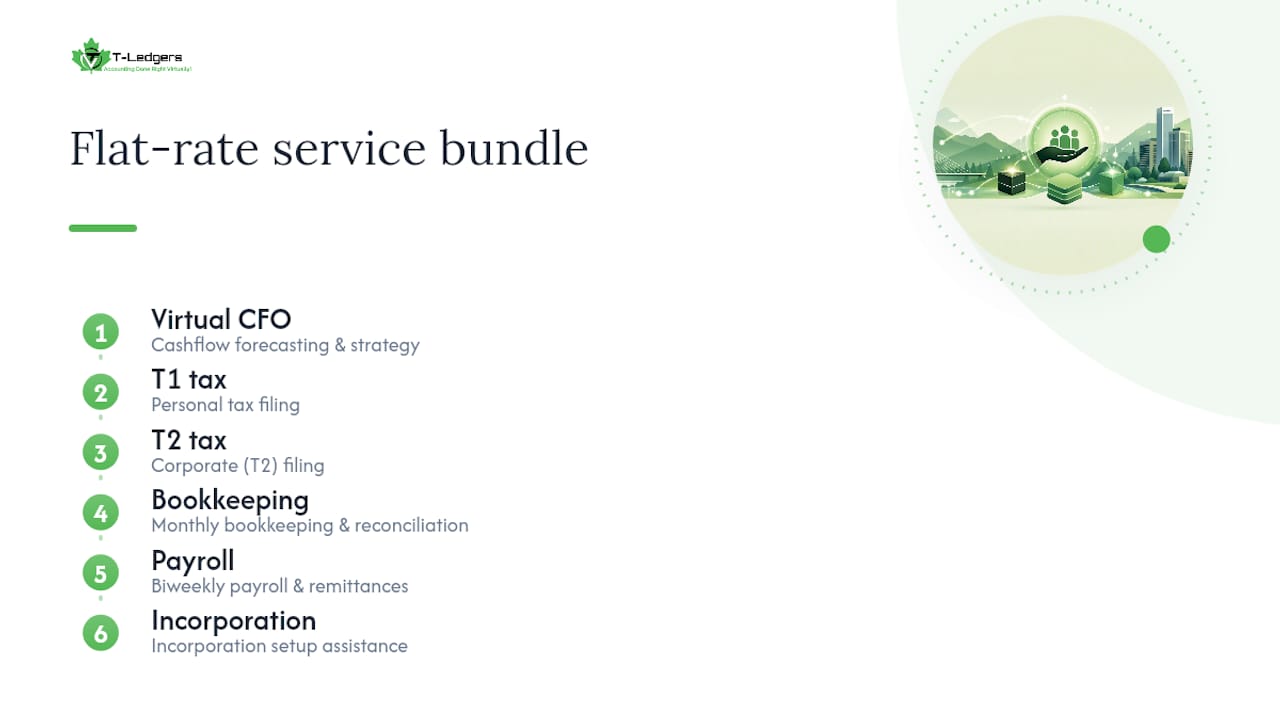
The service list includes virtual CFO support for cashflow forecasting and financial strategy, corporate (T2) and personal (T1) tax filing, monthly bookkeeping and reconciliation, payroll processing and remittances, and incorporation assistance. The pricing model is based on flat-rate fees. For a Coquitlam contractor billing project by project, or a retail owner watching seasonal cashflow swings, that predictability turns bookkeeping from a lingering anxiety into a fixed line item. Trust signals matter here too: a CPA-led team, documented client testimonials, and a secure client portal for exchanging records without email attachments floating around unsecured.
Picture two scenarios. A freelance designer in Coquitlam who’s outgrown spreadsheet bookkeeping and needs T1 filing plus quarterly check-ins. A ten-employee logistics business that needs payroll running on time every two weeks and a T2 filed without a scramble in month five. Both fit the same flat-rate model, just different packages.
Pro Tip: Ask any firm you’re considering to show you a sample deliverable, like a monthly financial report, before you sign anything. If they can’t produce one, that’s your answer.
Not every business needs every service on day one. Matching the right offer to your actual stage saves money and prevents you from paying for advisory work you’re not ready to use yet.
Onboarding typically starts with a document handoff, moves to monthly bookkeeping close, and settles into a quarterly review cadence for anything advisory.
Choosing an accountant shouldn’t feel like a leap of faith. A short, direct set of questions separates a firm that will actually serve your business from one that just sounds good on a landing page.
Start with credentials. Confirm the firm employs CPA-designated accountants and that the firm itself is registered with the provincial regulator, since licensing and discipline for public accounting are handled at the provincial level even though CPA Canada coordinates the designation nationally. That registration is your baseline assurance the firm answers to a professional body if something goes wrong.
Ask these questions directly during any consultation:
Watch for red flags. A firm that won’t put scope in writing, hedges on insurance coverage, or gives vague answers about CRA authorization is telling you something. A structured checklist or directory can speed up your shortlist, and a simple scorecard, rating each firm on responsiveness, clarity, and credentials, makes comparing three or four candidates far less confusing than trying to hold it all in your head.
Flat-rate pricing means you agree on a fee upfront that covers a defined scope, monthly bookkeeping, year-end filings, and a set number of advisory hours, with the fee remaining fixed regardless of time spent. Hourly billing shifts that risk onto you. For budgeting purposes, flat-rate is easier to plan against, particularly for businesses still finding their monthly rhythm. When requesting a quote from any firm, ask what triggers an additional charge outside the flat fee, and get it in writing.
Deadlines don’t move regardless of who’s doing your books. Self-employed individuals must file their T1 by June 15, 2026, but any balance owing for the 2025 tax year is due by April 30, 2026, and missing that payment date triggers interest even if you file on time in June.
Key deadline: Corporate (T2) returns are due six months after fiscal year-end, with balances owing generally due within two to three months depending on the corporation’s status. QuickBooks Canada confirms these same T1, T2, and GST/HST instalment timing rules for small-business planning.
This article’s tax deadline and credential guidance is reviewed under the editorial oversight of Wajahat Ajmal, CPA, whose professional standing anchors the advice given here.
Beyond the credential, look for concrete signals when evaluating any firm:
Most guides on choosing an accountant spend too much time on generic advice, like “check their reviews,” and not enough time on what actually predicts a good working relationship: whether the firm will put its scope, fees, and deliverables in writing before you sign anything.
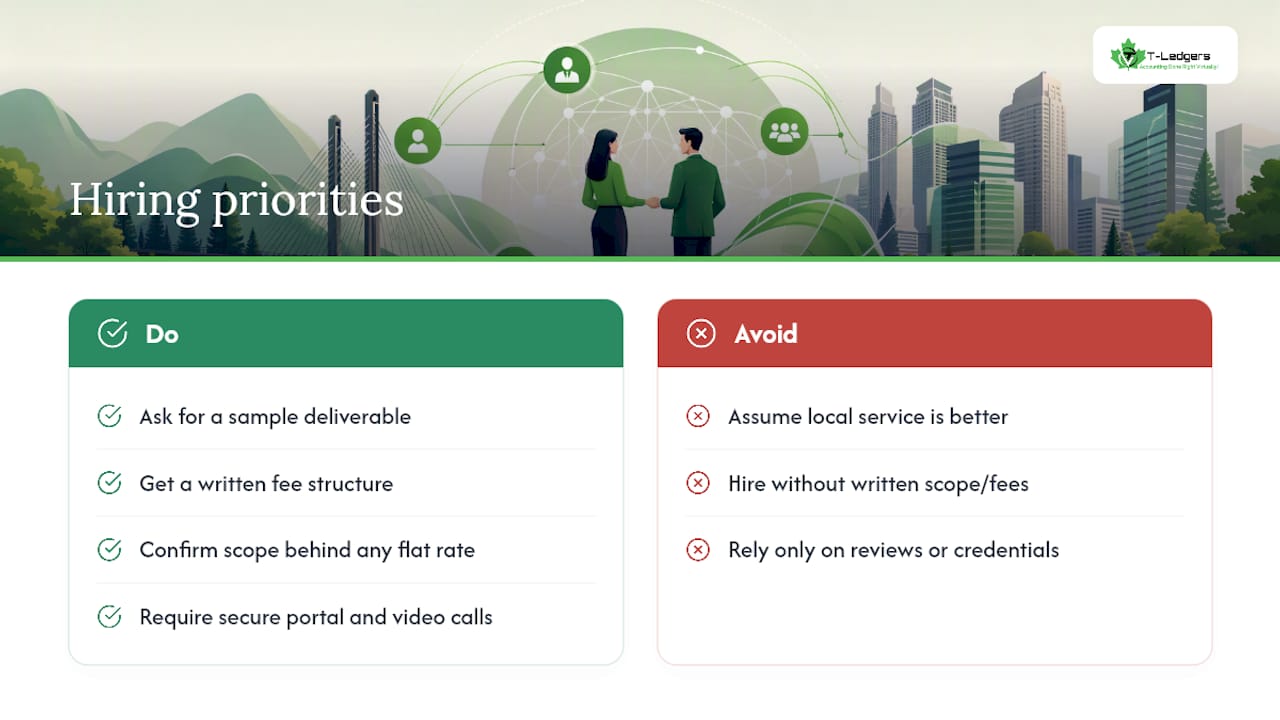
The conventional wisdom that local, in-person service is inherently more trustworthy than remote delivery doesn’t hold up well anymore. A secure client portal and a scheduled video call can deliver faster turnaround than a firm that requires you to drive across Coquitlam to drop off a folder of receipts. What matters is whether the communication is explicit, not whether the office has a physical address you can visit.
If I had to boil this down to one priority for a Coquitlam business owner reading this before a first consultation: ask for a sample deliverable and a written fee structure before you ask anything else. Everything else, credentials, testimonials, software stack, matters less if the firm can’t show you what a normal month of working together actually looks like. Flat-rate pricing solves a real problem, unpredictable invoices, but only if the scope behind that flat rate is spelled out clearly from day one.
— Wajahat Ajmal (CPA)
T-Ledgers Accounting offers consolidated accounting services with a single team, a single fee, and one point of contact for multiple services including payroll and year-end filing.

Getting started takes less prep than you’d expect. Have these ready for your first meeting:
After you book a consultation, the next steps are a short onboarding call and an engagement letter outlining your flat-rate scope, so there’s no ambiguity about what’s included before any work begins. If advisory support is what you’re after specifically, cashflow forecasting, KPI tracking, financial strategy, the virtual CFO page outlines what that engagement looks like in practice.
Filing and payment deadlines cited above come from Canada.ca’s 2026 tax deadlines page and QuickBooks Canada. Credential and selection guidance draws on CPA Guide, IFAC’s Canada profile, and the Tech Help Canada directory.
It’s less about the total cost and more about predictability. Flat-rate pricing means your fee is fixed for a defined scope, so a longer month doesn’t trigger a bigger invoice.
Yes, provided the firm uses a secure client portal and scheduled communication. T-Ledgers Accounting delivers services remotely with structured onboarding designed for exactly this kind of client relationship.
Self-employed individuals can file their T1 by June 15, 2026, but any balance owing must still be paid by April 30, 2026, to avoid interest.
Corporate (T2) returns are due six months after the fiscal year-end, with balances owing generally due within two to three months depending on the corporation’s status.
Bring your last filed tax return, recent bookkeeping records or bank statements, payroll records if applicable, and your business number if incorporated.
This article is intended to inform readers in general terms. It is not intended to provide any tax or business advice. Please consult your T-Ledgers advisor if you have any questions about your unique situation. While we have tried to ensure the accuracy of the information in this article, we accept no liability for errors or omissions.