


About UsPricingReviewsContact UsClient Portal loginBook a Free 30-Min Call
Last updated: October 16, 2026
The Productivity Mega Deduction is a proposed permanent measure that lets businesses fully deduct the cost of most eligible depreciable property in the year it becomes available for use, rather than spreading that deduction over several years. It applies to property acquired on or after September 15, 2026. The proposals are still draft legislation, so the details could change before they become law.
TL;DR:
- The deduction allows full immediate expensing of eligible property, but only if the asset is held beyond typical recapture triggers and within the draft legislation limits.
- Non-corporate taxpayers, such as individuals and trusts, face income limits and scrutiny, especially for related-party or non-arm’s-length transactions.
- Assets like buildings, patents, certain vehicles, and used property from related parties generally do not qualify, requiring careful asset classification before claiming the deduction.
- Selling or disposing of an asset after immediate expensing can result in significant recapture of taxes, especially if the sale price exceeds the remaining undepreciated capital cost.
- Planning should focus on modeling asset disposal timing and recapture risk before claiming the deduction, as the measure is still draft legislation and subject to change.
The Productivity Mega Deduction, often shortened to PMD, is a timing measure. Under the normal capital cost allowance (CCA) system, a business claims a percentage of an asset’s cost each year, subject to the half-year rule and accelerated investment incentive. The PMD instead lets an eligible business deduct the full cost immediately. It does not increase total depreciation over the asset’s life. It simply moves the deduction forward, improving cash flow in the year of purchase.
The federal government frames the measure as a competitiveness tool. Draft proposals suggest the deduction would extend immediate expensing to roughly two-thirds of capital investment and lower the marginal effective tax rate to about 6.4%.
Two features stand out for planning purposes:
Understanding this timing effect is the foundation for everything else in this guide, especially the recapture mechanics covered later.
Eligibility depends heavily on how the business is structured. Corporations and partnerships made up entirely of corporate partners get the most flexibility.
If your business operates as a sole proprietorship or a partnership with individual partners, model your expected business income carefully before assuming you can claim the full deduction. A loss-making year removes the benefit entirely for that period, though the unused CCA typically carries forward under the normal pool rules.
Most machinery, equipment, and computer hardware used in an active business will likely qualify, but the draft legislation carves out several categories that businesses commonly assume are included.
Before committing capital, check the asset’s CCA class against the current draft schedule. A misclassified purchase, particularly one bought from a related company, is one of the most common ways an expected deduction disappears on review.
This is the part of the Productivity Mega Deduction that catches business owners off guard. When you immediately expense an asset, its undepreciated capital cost (UCC) drops to zero right away. That is fine as long as you keep the asset. The trouble starts when you sell it, trade it in, or otherwise dispose of it.
Tax advisers describe this as a UCC reduction that leaves less or no pool to offset future proceeds, according to Morningstar’s commentary on the measure, which means the excess is included in income as recapture rather than offset against cost. This is exactly why forecasting matters before you claim the deduction, not after.
Mitigations exist. Taxpayers can elect out of immediate expensing for certain assets, such as Class 10.1 passenger vehicles, preserving future CCA deductions instead of taking the full hit in year one. Where replacement property rules apply elsewhere in the Income Tax Act, some deferral of recapture may be possible, though this depends on the specific class and transaction.
Pro Tip: Before claiming full immediate expensing on a high-value asset, model your expected holding period and resale value: if you plan to sell within a few years, weigh the year-one cash benefit against the tax bill recapture will trigger on disposal.
As a simple illustration: say a business immediately expenses $100,000 of equipment, dropping that class’s UCC to zero. If it later sells the equipment for $40,000, that entire $40,000 is recaptured into income in the year of sale, since there is no remaining UCC to absorb the proceeds. This example is demonstrative only, not a prediction of any actual transaction.
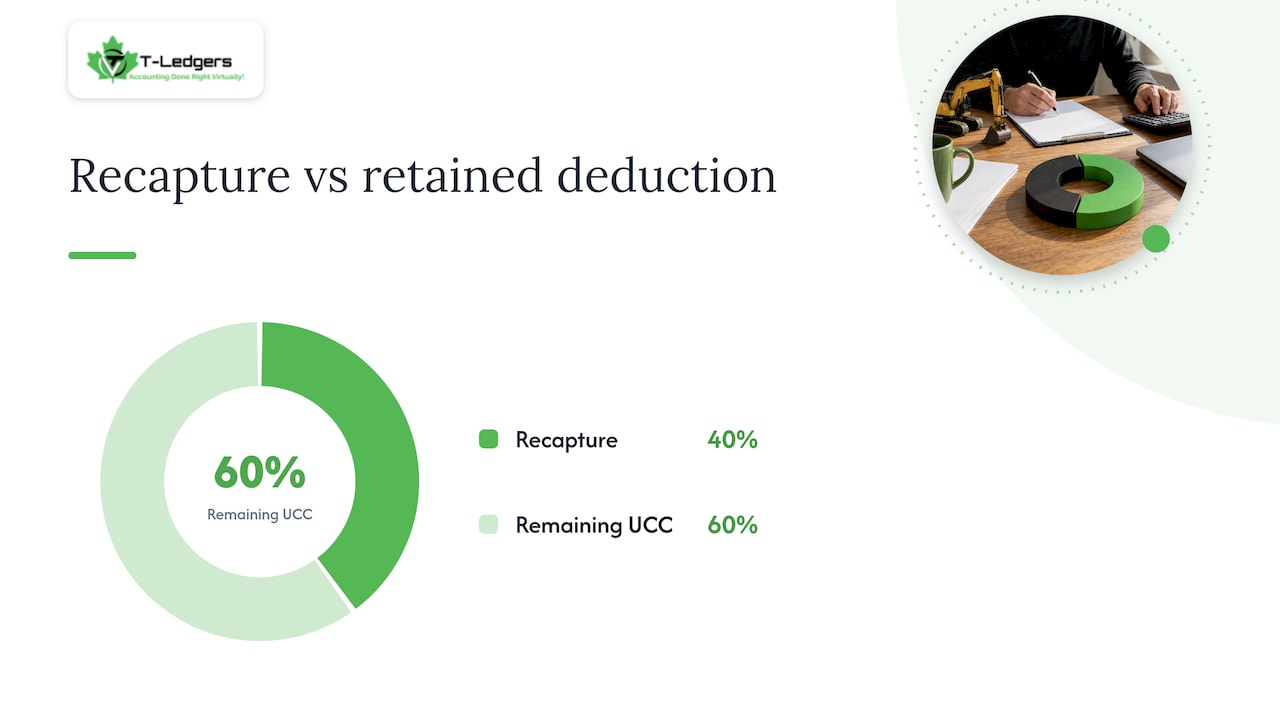
Boards and finance teams should treat the Productivity Mega Deduction as a planning trigger, not an automatic election.
There is an accounting dimension too. Immediate expensing creates a timing difference between tax and book depreciation, which typically requires a future income tax provision under Canadian GAAP and can affect reported net income and covenant calculations.
Pro Tip: A piece of equipment you expect to hold for its full useful life is a strong candidate for immediate expensing; one you plan to flip or upgrade within two or three years may be better served by electing out and keeping the CCA pool intact.
The Productivity Mega Deduction is not yet law. Finance Canada released draft legislative proposals on September 15, 2026, and the measure still needs to go through a consultation period, possible amendments, formal introduction as a bill, parliamentary review, and Royal Assent before it takes effect. The timeline for that process is not fixed.
Until final legislative text and CRA administrative guidance are published, avoid locking in irreversible tax elections or major capital decisions based solely on the draft rules. Treat current guidance as a strong signal of direction, not a finished rulebook.
Most coverage of the Productivity Mega Deduction focuses on the upfront cash-flow win. That is the easy part to sell to a board. The harder, more important conversation is what happens three or five years later when that same asset is sold, upgraded, or retired, and the deferred tax bill comes due in a single year.
Our short-run advice: triage your capex pipeline now, confirm available-for-use dates, and model recapture exposure before you claim the deduction, not after you file. Medium term, update your capital acquisition policy so every purchase carries a documented disposal and recapture assessment alongside the standard cost-benefit analysis, and brief your board on the difference between a tax deferral and a permanent tax saving.

Businesses that treat the Productivity Mega Deduction as free money without modelling the exit will find the recapture bill lands exactly when cash is tightest, at the point of sale.
If you want help building that capex and recapture model, T-Ledgers’ Corporate Tax and GST Filing service and Virtual CFO support both cover this kind of forecasting as part of flat-rate engagements.
— Wajahat Ajmal (CPA)
This article is general information, not a substitute for advice from a qualified financial advisor. Consult a qualified financial professional about your own circumstances before acting on anything here.
The Productivity Mega Deduction is a proposed permanent measure allowing eligible businesses to immediately expense the full cost of most depreciable capital property in the year it becomes available for use, rather than claiming it gradually through normal CCA rates. It is currently draft legislation, not enacted law.
This question does not correspond to a published CRA rule tied to the Productivity Mega Deduction or standard CCA administration. If you are thinking of a specific retention or reassessment period, check directly with a CRA source or a tax professional rather than relying on an informal label.
The government’s own framing of the Productivity Mega Deduction positions it as a tool to strengthen competitiveness among G7 countries for new business investment, rather than citing a specific productivity ranking. No source in this article states a numeric ranking, so none is given here.
This article does not cover capital gains exemption thresholds, and no source used here addresses that figure for 2026. For current thresholds, check directly with the Canada Revenue Agency or a tax professional.
Yes. Since immediate expensing reduces the asset’s UCC to zero, proceeds from a later sale are largely treated as recapture and added to taxable income in the year of disposal. Modelling this exposure before claiming the deduction helps avoid an unexpected tax bill later.
This article is intended to inform readers in general terms. It is not intended to provide any tax or business advice. Please consult your T-Ledgers advisor if you have any questions about your unique situation. While we have tried to ensure the accuracy of the information in this article, we accept no liability for errors or omissions.