Close
  • Home
  • About Us
  • Services
  • Packages
  • Blog
  • Reviews
  • Our Approach
  • Contact Us
  • (866) 254-5368
  • info@tledgers.ca
  • Mon-Fri 9am - 8pm
Book a 15-Min Call
T-Ledgers Logo animated
  • Home
  • About Us
  • Services
      Virtual CFO

      Services of a CFO without the CFO Salary!

      Learn More

      Personal Tax

      Looking to file Personal Tax? We have got you covered.


      Learn More

      Corporation Tax and GST/HST Filing

      Get your Corporate Taxes and GST filed with ease.

      Learn More

      Bookkeeping Services

      Worry less of your books and get bookkeeping done at a flat fee!

      Learn More

      Payroll Services

      Outsource your Payroll to us and we will ensure everyone is paid on time.

      Learn More

      Incorporation Services

      Learn how we can help you in incorporating your company.

      Learn More

  • Packages
  • Blog
  • Reviews
  • Our Approach
  • Contact Us
Linkedin Facebook Instagram

T-Ledgers Logo animated
  • Home
  • About Us
  • Services
      Virtual CFO

      Services of a CFO without the CFO Salary!

      Learn More

      Personal Tax

      Looking to file Personal Tax? We have got you covered.


      Learn More

      Corporation Tax and GST/HST Filing

      Get your Corporate Taxes and GST filed with ease.

      Learn More

      Bookkeeping Services

      Worry less of your books and get bookkeeping done at a flat fee!

      Learn More

      Payroll Services

      Outsource your Payroll to us and we will ensure everyone is paid on time.

      Learn More

      Incorporation Services

      Learn how we can help you in incorporating your company.

      Learn More

  • Packages
  • Blog
  • Reviews
  • Our Approach
  • Contact Us
Instagram Linkedin Facebook
Uncategorized

Accounts payable process for small businesses: a step-by-step guide

By w.ajmal@ringacpa.ca 

The accounts payable process is the step-by-step workflow your business uses to verify supplier invoices and turn them into authorised payments while protecting cash flow and preventing fraud. Your immediate priority: centralise all invoice intake into one channel and enforce at least two approval checkpoints before any payment leaves your account. Two benchmarks worth knowing from the start are Days Payable Outstanding (DPO) and cost per invoice, both of which signal whether your AP workflow is healthy or quietly costing you money. For Canadian businesses, the Canada Revenue Agency (CRA) also sets specific rules around GST/HST on vendor invoices that affect how you code and record every purchase. AP cycles typically run for several weeks depending on supplier terms, so getting the workflow right early prevents compounding delays.

Table of Contents

  • What does the accounts payable process look like step by step?
  • How does three-way matching work, and when do you need it?
  • Segregation of duties, manager accountability, and Canadian compliance
  • Which AP metrics should you track?
  • How long does the AP process take, and what causes delays?
  • When should you automate your AP workflow?
  • Ready-to-use AP checklists and workflow table
  • Key takeaways
  • Why AP controls matter more than most small businesses realise
  • Tledgers helps you build a clean AP process from day one
  • Useful sources
  • FAQ

What does the accounts payable process look like step by step?

A well-run AP workflow moves in a clear sequence. Here is the full cycle, from purchase to ledger entry.

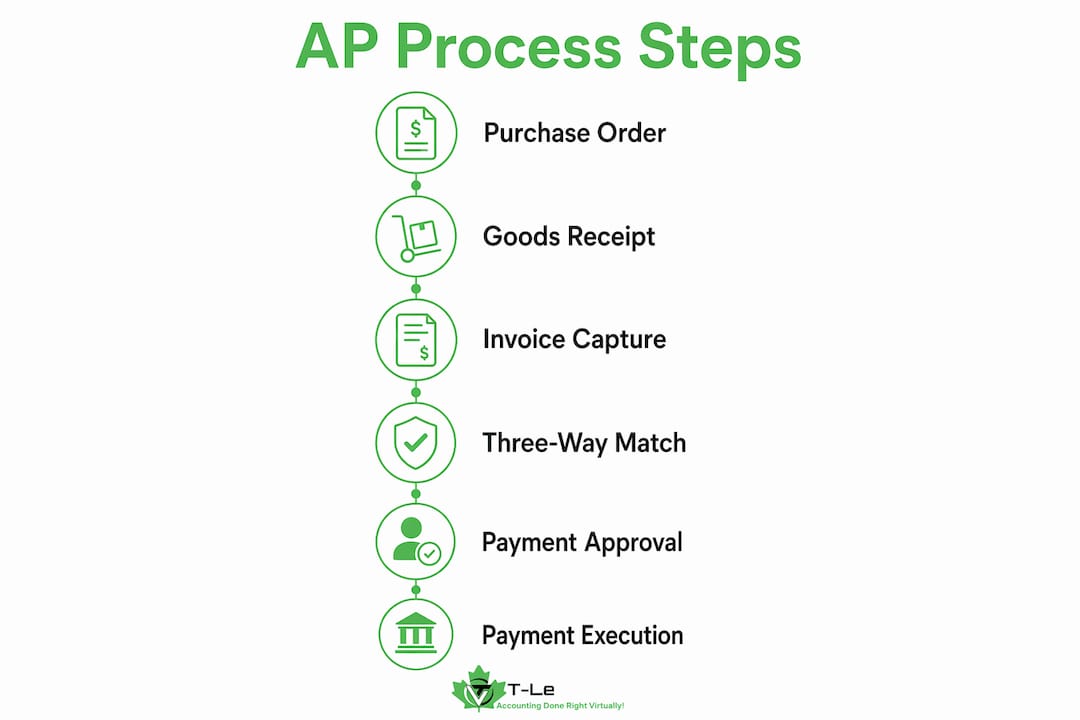
  1. Place the order. Procurement issues a purchase order (PO) to the vendor, confirming quantities, prices, and delivery terms. The PO number becomes the tracking reference for every document that follows.
  2. Receive goods or services. The receiving team captures a goods receipt note (GRN) confirming what arrived, in what quantity, and in what condition.
  3. Receive the invoice. Use a dedicated email address or vendor portal so all invoices land in one place. Accounting software can automatically scan emailed invoices and populate amounts and due dates.
  4. Capture and code the invoice. An AP clerk enters the invoice into your ledger, assigns the correct general ledger (GL) code, and flags the applicable GST/HST amount.
  5. Match the invoice. Compare the invoice against the PO and, where goods were involved, the GRN. This is the three-way match step covered in detail below.
  6. Route for approval. Send the matched invoice to the designated approver. High-value invoices should require manager sign-off; low-dollar recurring invoices can follow a faster track.
  7. Schedule payment. Align the payment date with your cash flow forecast. Consider early-payment discounts where your cash position allows, but weigh discounts against available cash before committing.
  8. Execute payment. Transfer funds via EFT, cheque, or your payment platform. Confirm the vendor’s bank details match your verified vendor master file before every new payment.
  9. Record and reconcile. Post the payment to the ledger, clear the AP liability, and reconcile the bank statement at month-end.

Roles and responsibilities

TaskResponsible party
Issue purchase orderProcurement / department manager
Capture goods receiptReceiving / warehouse team
Code and enter invoiceAP clerk
Approve paymentFinance manager / controller
Execute bank transferFinance controller / treasurer
Month-end reconciliationBookkeeper / controller

Pro Tip: Set a small-dollar threshold, say $100 or less, where pre-approved recurring invoices from verified vendors skip the full approval queue. This speeds low-value transactions without removing the vendor-verification control that matters most.

How does three-way matching work, and when do you need it?

Three-way matching compares three documents before releasing payment: the purchase order (what you agreed to buy), the goods receipt note (what actually arrived), and the supplier’s invoice (what the vendor is charging). When all three agree within a set tolerance, the invoice is approved. When they disagree, the exception goes to a named reviewer.

Hands comparing three AP documents on table

The table below shows how to handle common document combinations.

PO presentGRN presentInvoice matchesAction
YesYesYesApprove and schedule payment
YesYesPartial (quantity short)Pay received portion; hold remainder
YesNoYesHold; request GRN from receiving team
NoN/AYesHold; investigate missing PO
YesYesNo (price mismatch)Flag exception; contact vendor for revised invoice or credit memo

For exceptions, the AP clerk contacts the vendor, documents the outcome (credit memo, revised invoice, or partial payment), and records the resolution in the invoice file. A good rule of thumb: require three-way matching for tier-1 suppliers and any purchase above your defined dollar threshold; allow two-way or card payments for recurring low-risk vendors.

Segregation of duties, manager accountability, and Canadian compliance

No single person should onboard a vendor, enter their invoice, and authorise the payment. That concentration of access is where fraud takes root. Federal financial management guidance is explicit: managers are accountable for verifying and certifying expenditures, and duties must be separated across different individuals.

Canadian compliance checklist

  • Verify GST/HST registration numbers on vendor invoices before claiming input tax credits; the CRA requires a valid registration number for any claim above $30.
  • Retain all AP records, including invoices, POs, GRNs, and payment confirmations, for a minimum of six years per CRA requirements.
  • Store records in a format the CRA can access during an audit (paper or electronic).
  • Apply the correct HST rate for Nova Scotia (15%) when coding vendor invoices from suppliers in the province.
  • Require a written vendor-setup request and dual review of any bank-account change, with timestamps and approver IDs logged for every modification.
  • Run dual approvals for any new vendor added to the master file.
  • Never allow the same employee to both add a vendor and approve that vendor’s first invoice.

For corporate tax filing purposes, well-maintained AP records also make year-end significantly faster and reduce the risk of disallowed deductions.

Which AP metrics should you track?

Effective AP management requires monitoring a short list of KPIs that reveal where your process is healthy and where it is stalling.

KPIFormulaWhat it reveals
Days Payable Outstanding (DPO)(AP balance ÷ COGS) × days in periodHow long you take to pay suppliers
AP turnover ratioTotal purchases ÷ average AP balanceHow frequently you clear your payables
Cost per invoiceTotal AP operating cost ÷ invoices processedEfficiency of your AP function
Invoice exception rateExceptions ÷ total invoices processedQuality of your matching and coding
On-time payment rateOn-time payments ÷ total paymentsVendor relationship health

A monthly KPI trend chart for management review should highlight DPO movement against your target payment terms, cost per invoice versus prior periods, and exception rate as a proxy for data quality. When DPO climbs unexpectedly, it usually signals an approval bottleneck or a cash-flow constraint worth investigating.

How long does the AP process take, and what causes delays?

AP stageTypical durationCommon delay cause
Invoice receipt to captureSame day to 2 daysNo dedicated inbox; invoices lost in general email
Capture to matching1–2 daysMissing PO or GRN; incorrect GL code
Matching to approval1–3 daysApprover unavailable; no escalation path
Approval to payment schedulingSame day to 1 dayCash flow constraints; manual scheduling
Payment execution1–3 daysIncorrect bank details; EFT processing time
Total (clean invoice)3–7 business days

When an invoice stalls, run these checks immediately:

  • Confirm the invoice was received in the central inbox, not a personal email.
  • Verify the PO number on the invoice matches an open PO in your system.
  • Check whether the GRN has been entered by the receiving team.
  • Confirm the approver has been notified and has not been out of office without a delegate set.
  • Verify vendor bank details against the master file before re-attempting payment.

When should you automate your AP workflow?

Manual AP scales poorly. As invoice volume grows, headcount tends to grow linearly alongside it, which means administrative costs rise in direct proportion to your business. Automation breaks that pattern by handling routine matching, coding, and routing without adding staff.

Core benefits of AP automation:

  • Lower cost per invoice through OCR capture and automated data entry.
  • Faster cycle times, from days to hours for clean invoices.
  • Automated two-way and three-way matching with configurable tolerances.
  • Electronic approval workflows with mobile access for approvers.
  • Timestamped audit trails that deter fraud and simplify CRA audits.
  • Integration with your ledger or ERP for real-time cash-balance visibility.

Phased migration plan

  1. Pilot phase. Select five to ten low-risk, recurring suppliers. Centralise their invoices into one inbox and configure basic approval routing.
  2. Integration phase. Connect your AP tool to your accounting ledger (QuickBooks, Xero, or similar). Confirm GL codes and GST/HST fields map correctly.
  3. Matching phase. Enable automated two-way matching for service invoices and three-way matching for goods purchases above your threshold.
  4. Full rollout. Expand to all suppliers, set KPI targets for each phase, and assign exception ownership to a named team member.

Pro Tip: Before go-live, identify your top ten exception causes from the current process and configure automated routing rules so each exception reaches the right approver immediately, rather than sitting in a generic queue.

If your AP and payroll processes overlap, for example when paying contractors or processing employee expense reimbursements, a payroll consultation can help you align both workflows before automating.

Ready-to-use AP checklists and workflow table

Invoice approval checklist

  • PO number confirmed and matches an open PO.
  • Goods receipt note on file (for physical goods).
  • Invoice amount matches PO within tolerance.
  • GL code assigned correctly.
  • GST/HST amount identified and input tax credit eligibility confirmed.
  • Approval signature obtained from authorised manager.
  • Payment terms and due date recorded.

Vendor onboarding checklist

  • Legal business name and address verified.
  • CRA business number confirmed (where applicable).
  • GST/HST registration number verified for vendors charging HST.
  • Bank account details received via secure channel and dual-reviewed.
  • Vendor-setup request form signed and filed.
  • Payment terms agreed and documented.
  • Vendor added to master file with approver ID and timestamp logged.

Sample AP workflow table

StepDocumentResponsible partyOutput
Order placedPurchase orderProcurementPO number issued
Goods receivedGoods receipt noteReceiving teamGRN filed
Invoice receivedSupplier invoiceAP clerkInvoice logged
Invoice codedCoded invoiceAP clerkGL code + GST/HST assigned
Three-way matchPO + GRN + invoiceAP clerk / systemMatch confirmed or exception raised
ApprovalApproved invoiceFinance managerPayment authorised
Payment executedPayment recordControllerFunds transferred
Ledger entryJournal entryBookkeeperAP liability cleared

Infographic illustrating step-by-step accounts payable process

Key takeaways

A well-controlled accounts payable process requires centralised invoice intake, enforced segregation of duties, consistent three-way matching for goods purchases, and regular monitoring of DPO and cost per invoice to catch bottlenecks before they affect vendor relationships.

PointDetails
Centralise invoice intakeUse one dedicated inbox or portal so no invoice is lost in personal email.
Enforce segregation of dutiesNo single person should onboard a vendor, enter invoices, and approve payments.
Apply three-way matchingMatch invoice, PO, and GRN for all goods purchases above your dollar threshold.
Track DPO and cost per invoiceThese two KPIs together show both timing health and process efficiency.
Tledgers for Canadian AP supportTledgers provides flat-rate bookkeeping and virtual CFO services to implement AP controls and GST/HST compliance for Canadian businesses.

Why AP controls matter more than most small businesses realise

Most AP problems are not discovered during the invoice cycle. They surface at year-end, during a CRA audit, or when a vendor relationship breaks down over a disputed payment. By then, the root cause, usually a missing control or an unchecked exception, is months old and harder to unwind.

The businesses that handle AP well tend to share one habit: they treat it as a cash-flow management tool, not just a bill-paying function. Deciding whether to take an early-payment discount is a financial decision with real impact on your working capital. Letting invoices pile up in a shared inbox is not a minor inefficiency; it is a direct risk to your vendor relationships and your audit readiness.

Automation helps, but it does not replace the controls. An automated system with poor vendor master-file hygiene will process fraudulent invoices faster than a manual one. The controls come first. The technology makes them faster and more consistent.

Tledgers helps you build a clean AP process from day one

Getting AP right from the start is far less costly than fixing it after a fraud incident or a CRA review. Tledgers offers flat-rate bookkeeping services and virtual CFO support designed specifically for Canadian small businesses, including Nova Scotia companies that need controls-first AP setup without the overhead of a full-time finance team.

Tledgers

With Tledgers, you get a remote CPA team that configures your AP workflow, handles GST/HST coding on vendor invoices, and keeps your records audit-ready for CRA. The flat-rate model means you know exactly what you are paying each month, with no hourly surprises. Whether you need a full AP process built from scratch or ongoing bookkeeping to maintain it, the next step is straightforward: book a discovery call and let Tledgers assess where your current process stands.

Useful sources

  • CRA GST/HST guidance: The primary source for input tax credit rules, registration number requirements, and record-retention timelines for Canadian businesses.
  • Treasury Board financial management policy: Government of Canada guidance on segregation of duties and manager certification; the authoritative reference for AP internal controls.
  • Sage Canada: AP best practices: Practical guidance on KPI monitoring, workflow standardisation, and automation for Canadian businesses.
  • RBC: Accounts payable guide: Covers AP’s role in cash-flow management and the trade-off between early-payment discounts and cash on hand.
  • AccountingTools: Three-way matching: Clear definition and practical explanation of three-way matching and when to apply it.
  • Tledgers bookkeeping services: Flat-rate bookkeeping and AP support for Canadian small businesses, including GST/HST compliance and audit-ready record-keeping.
  • Tledgers virtual CFO: Strategic financial oversight including AP process design, cash-flow management, and CRA compliance for growing businesses.

FAQ

What are the steps in the accounts payable process?

The AP process runs from purchase order issuance through goods receipt, invoice capture and coding, three-way matching, approval, payment scheduling, payment execution, and ledger reconciliation. Most clean invoices complete the full cycle in 3–7 business days.

What is three-way matching in accounts payable?

Three-way matching compares the supplier’s invoice against the original purchase order and the goods receipt note before releasing payment. It is the standard control for physical goods purchases and helps prevent fraud and duplicate payments.

What are the rules for accounts payable in Canada?

Canadian businesses must retain GST/HST registration numbers on vendor invoices to claim input tax credits, keep all AP records for a minimum of six years per CRA requirements, and apply the correct provincial HST rate when coding invoices. Segregation of duties is also a core requirement under federal financial management guidelines.

How long does the accounts payable process take?

A clean invoice with a matching PO and GRN typically processes in 3–7 business days. Overall AP cycles run 30–90 days depending on supplier payment terms. Missing documents, manual approvals, and incorrect vendor bank details are the most common causes of delays beyond that range.

Recommended

  • DIY Bookkeeping vs. Professional Services: Accounting for Corporation – T-Ledgers
  • Payroll Services – T-Ledgers
  • Bookkeeping – T-Ledgers
  • Catch up Bookkeeping – T-Ledgers

Leave A Reply Cancel reply

Your email address will not be published. Required fields are marked *

*

*

Woman reviewing Canadian small business payroll documents
Best payroll software for Canadian small businesses
Previous Article
Owner comparing Stripe and Square payment devices
Stripe vs Square for Canadian small businesses
Next Article

OUR PARTNERS
Dext Logo
Caseware Logo
Xero Logo
Stripe Logo
Practice Ignition Logo
Payment Evolution Logo
QuickBooks logo
Humi Logo
Hubdoc Logo
Harvest Logo
Wolters Kluwer Logo
Common Tax Mistakes Guide picture
Get a Chance to Learn
MOST COMMON TAX MISTAKES
That target a CRA Audit
T-Ledgers Logo animated
  • info@tledgers.ca

  • (647) 923-4031            
  • (888) 682-8775Fax
  • (866) 254-5368Landline
      • 102-89 Skyway Ave, Etobicoke, Ontario,
        M9W 6R4 (Meetings by Appointment Only)Address 
Quick Links
  • Home
  • About Us
  • FAQ
  • Services & Pricing
  • Our Clients
  • Blog
  • Our Approach
  • Contact Us
  • Terms and Conditions
  • Privacy Policy
Our Services
  • Virtual CFO
  • Personal Tax (T1)
  • Corporate, Self Employed & GST Taxes
  • Bookkeeping Services
  • Incorporation Services
  • Client Portal
Worksheets
  • Personal Tax Worksheet

  • Bookkeeping and Corporation Tax Onboarding

Resources
QuickBooks Prodadvisor Elite Badge
Wagepoint Certified
T-Ledgers Accounting Inc BBB Business Review
CLICK HERE TO GET
BOOKKEEPING TEMPLATE
Linkedin Facebook Instagram
© 2026 T-Ledgers Accounting Inc. The T-Ledgers Logo & Design is a registered trademark of T-Ledgers Accounting Inc., Canadian Trademark Registration No. TMA1,401,783. All rights reserved.